

Joint pain and tendon injuries can make everyday activities harder than they should be. Whether discomfort begins after a sports injury, develops from arthritis, or keeps returning with activity, patients often want to explore treatment options before considering surgery.
Platelet-rich plasma treatment, commonly called PRP treatment, is a non-surgical orthobiologic option that uses a concentrated portion of a patient's own blood. We provide ultrasound-guided PRP injections for eligible patients from Boca Raton, Boynton Beach, Delray Beach, and nearby South Florida communities.
What Is Platelet-Rich Plasma Treatment?
Platelets are a natural part of the blood. They are best known for helping the body form blood clots, but they also contain proteins and growth factors involved in the body's healing response.
PRP treatment begins with a small blood draw. The blood sample is placed in a centrifuge, which separates and concentrates the platelet-rich portion of the blood. This concentrated PRP is then injected into the targeted area, such as a tendon, ligament, or joint. Learn more about how Platelet-Rich Plasma (PRP) therapy works as part of our full range of orthobiologic treatments.
Because PRP is created from the patient's own blood, it is an autologous treatment. The goal is to deliver a concentrated sample of platelets to the area being treated.
What Conditions Can PRP Injections Treat?
PRP treatment may be considered for certain orthopedic conditions involving the shoulder, elbow, knee, tendons, ligaments, and joints. It is not appropriate for every condition, and a consultation is needed to determine whether it may be a reasonable option.
We evaluate PRP treatment for problems such as chronic tendonitis, partial-thickness tendon tears, knee osteoarthritis, shoulder arthritis, tennis elbow, golfer's elbow, patellar tendonitis, quadriceps tendonitis, MCL injuries, and selected meniscal injuries or shoulder labral injuries.
The best candidates are determined by the diagnosis, severity of damage, symptoms, activity level, imaging findings, and previous treatment history.
How Does PRP Treatment Work?
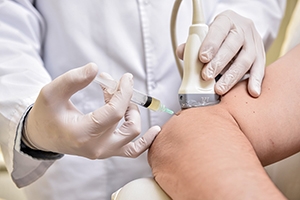
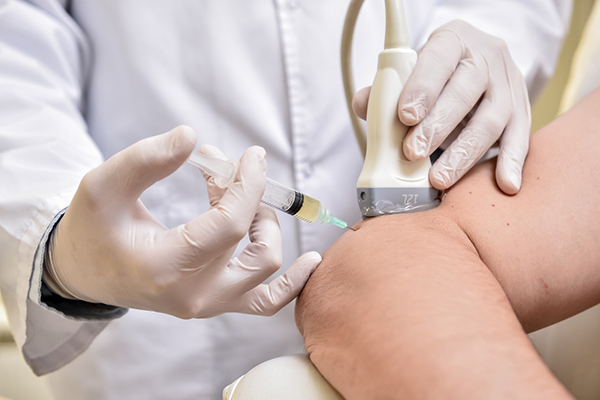
PRP treatment is designed to use the body's own biologic material in the area of injury or joint degeneration. After the PRP is prepared, it is delivered using ultrasound guidance.
Ultrasound allows the physician to view muscles, tendons, ligaments, and joints in real time. This guidance helps place the injection at the planned treatment location with precision.
Some PRP preparations are selected based on the condition being treated. For example, different PRP characteristics may be used for certain tendon, ligament, or arthritis-related concerns, and in some cases we may also consider Bone Marrow Aspirate Concentrate (BMAC) treatment as an alternative or complementary orthobiologic option. Your treatment plan is based on the specific diagnosis rather than a standard injection approach.
What Happens During a PRP Injection Appointment?
PRP injections are completed in the office and typically take about one hour from start to finish. First, a blood sample is drawn from the patient's arm. The sample is processed in a centrifuge to separate the platelet-rich plasma.
The treatment area is cleaned and prepared, and the injection is performed using sterile technique and ultrasound guidance. Most patients return home shortly after the appointment.
Patients may feel temporary soreness or discomfort at the injection site. This can be more noticeable with some tendon treatments, such as tennis elbow or golfer's elbow.
What to Expect After PRP Treatment
PRP is not an instant pain-relief treatment. It may take several weeks for patients to notice changes, and therapeutic relief may take approximately six to eight weeks. The recovery experience varies by condition and by patient.
Patients are commonly advised to avoid impact activity for the first week after the injection. Low-impact activity and gentle stretching may be recommended during this time. Physical therapy may also be an important part of the recovery plan, especially for tendon, ligament, or joint injuries.
Cold therapy may help manage post-injection soreness. Patients should follow their individualized medication instructions and speak with the care team before taking anti-inflammatory medication after PRP treatment.
Potential Benefits of PRP Treatment
For appropriately selected patients, PRP injections may offer a non-surgical option for managing some orthopedic conditions. The treatment may be used as part of a broader plan that includes activity modification, rehabilitation, and ongoing monitoring.
- A non-surgical treatment option using the patient's own blood
- Ultrasound-guided injections for targeted treatment delivery
- A personalized approach for joint, tendon, or ligament conditions
- The ability to combine treatment with a structured rehabilitation plan
PRP does not replace a thorough diagnosis, physical therapy, or surgery when surgery is necessary. Results vary, and no injection can guarantee pain relief or tissue healing.
Is PRP Treatment Right for You?
PRP treatment may be considered when pain from a tendon injury, ligament injury, or joint condition has not improved with rest, activity changes, physical therapy, or other conservative care.
However, PRP is not right for every patient or every orthopedic diagnosis. A complete evaluation helps determine whether PRP, medication, physical therapy, surgery, or another treatment is most appropriate.
We review the patient's symptoms, examination findings, imaging studies, medical history, and activity goals before recommending treatment. You can request an appointment online to begin a consultation.
Frequently Asked Questions
Q. Is PRP treatment surgery?
No. PRP treatment is a non-surgical injection procedure performed in the office.
Q. How long does a PRP appointment take?
The full visit usually takes about one hour, including the blood draw, PRP preparation, and ultrasound-guided injection.
Q. Does PRP treatment hurt?
Patients may feel discomfort during or after the injection. Soreness at the treatment site can last for several days, depending on the area treated.
Q. How soon will I feel results from PRP treatment?
PRP does not usually provide immediate relief. Some patients may begin noticing changes over several weeks, while the response varies based on the condition being treated.
Q. Can I exercise after a PRP injection?
Patients are generally advised to avoid impact activity for about one week. Your physician will provide instructions about safe activity, stretching, and physical therapy.
Risks and Side Effects of PRP Injections
PRP injections are generally considered to have a low risk profile, but every medical procedure has potential side effects. Temporary pain or soreness at the injection site may occur after treatment.
Other possible risks include infection, irritation of nearby nerves or tissues, scar tissue formation, or calcification at the injection site. Your physician will discuss the possible benefits and risks before treatment.
Dr. William P. Toole, MD, FAAOS is a board-certified, fellowship-trained orthopedic surgeon and sports medicine specialist serving patients across Boynton Beach, Boca Raton, Delray Beach, and the greater Palm Beach County area. A graduate of the honors college at Clemson University, Dr. Toole earned his medical degree with honors from the University of South Carolina School of Medicine and completed his orthopedic surgery residency at the University of Florida / Mayo Clinic Florida — one of the most respected training programs in the country. He is certified by the American Board of Orthopaedic Surgery, a Fellow of the American Academy of Orthopaedic Surgeons (FAAOS), and a member of the American Orthopaedic Society for Sports Medicine.
Prior to establishing his Florida practice, Dr. Toole served as Assistant Team Physician for four major professional sports franchises, the Houston Texans (NFL), the Houston Astros (MLB), the Houston Rockets (NBA), and the Houston Dynamo (MLS), bringing elite-level orthopedic experience to every patient he treats today. He specializes in arthroscopic and reconstructive surgery of the shoulder and knee, ACL reconstruction, rotator cuff repair, cartilage restoration, MACI procedures, and outpatient joint replacement, all performed using the latest minimally invasive techniques designed to get patients back to peak performance as quickly and safely as possible.


